U.S.S. Voyager Deck 1
Created by Captain Maohl Johrend on Sun May 3rd, 2026 @ 2:39pm
Bridge
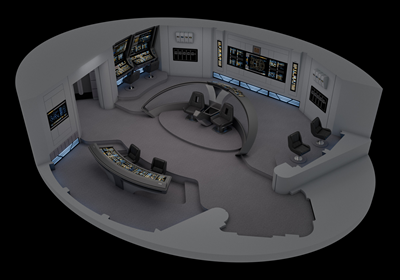 If Main Engineering serves as the heart of the U.S.S. Voyager-C, the Main Bridge is undoubtedly its brain and primary nerve center. As an Intrepid II Class starship, the Voyager-C’s Bridge design represents a sophisticated evolution of the deep-space explorer lineage, blending the sleek, high-automation standards of the late 25th Century with the classic, functional geometry pioneered by its predecessors. Located at the apex of Deck 1, this facility provides the Commanding Officer with a centralized platform to supervise every department and coordinate complex scientific missions with unparalleled precision.
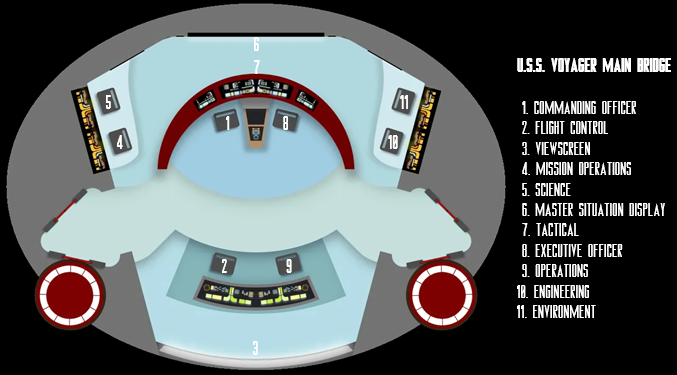
The physical environment of the Bridge reflects a transition toward a more integrated, high-visibility layout. The aesthetic is defined by clean lines and an open floor plan that emphasizes rapid information exchange. At the center of the room sits the command island, which breaks from the traditional three-chair layout to feature two primary command positions: the Captain and the Executive Officer. These chairs are positioned off-center, starboard and port respectively, with a specialized, shared command console between them. This interface allows both officers to access real-time telemetry, mission logs, and Red Alert protocols without leaving their seats.
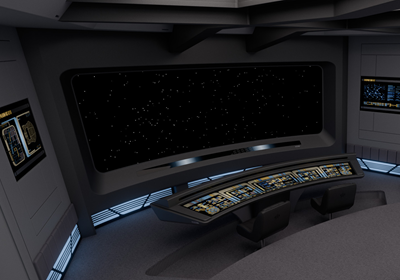
Directly forward and sunken into a dedicated "pit" are the combined Flight Control (Conn) and Operations (Ops) consoles. By placing these primary workstations at a lower elevation, the command team is granted an unobstructed line of sight to the massive forward viewscreen, which dominates the front of the Bridge. This display uses a high-resolution holographic matrix to render long-range sensor data and tactical overlays in three dimensions.
Defining the aft section of the room is the Tactical Arch — a signature structural and functional element of the Intrepid II Class Bridge. This elevated horseshoe-shaped console stands directly behind the command area, housing the ship’s primary defensive and security controls. By wrapping around the rear of the command center, the Tactical Arch ensures that the Tactical Officer is physically positioned to oversee all Bridge operations while maintaining immediate access to the ship’s weapons arrays and shield grids.
The perimeter of the Bridge is lined with specialized workstations that manage the vessel's multi-mission capabilities. Moving clockwise from the viewscreen, the consoles are dedicated to Mission Ops, Science, Environment, and Engineering. Each station utilizes a software-defined LCARS interface that can be instantly reconfigured to suit the current mission profile. Access to this critical hub is maintained through a redundant Turbolift network, with the main lifts located at the rear of the Bridge, while the Captain’s Ready Room and the Briefing Room are situated nearby for immediate tactical and diplomatic consultations.
Layout
Command Section
Command Stations
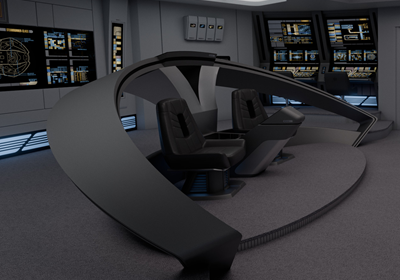
The Command Stations of the Voyager-C are the functional heart of the Bridge, designed to foster a highly collaborative relationship between the ship’s two senior-most officers. Departing from the three-seat arrangement typical of larger explorers, this Intrepid II Class vessel utilizes a streamlined dual-command configuration. The Captain and First Officer occupy individual, high-backed command seats situated side-by-side at the center of the Bridge. Positioned immediately behind the sunken Conn and Ops "pit," these chairs provide the Commanding Officers with an unobstructed line of sight to the Viewscreen while ensuring they remain centrally accessible to the various peripheral workstations located throughout the deck.A defining feature of this command hub is the specialized terminal positioned between the two chairs, which serves as the exclusive interface for command-level input. Drawing design inspiration from the Command Stations on the Galaxy Class, this multi-purpose interface acts as the shared intelligence station for both officers. By consolidating all controls into this single central unit, the Bridge maintains a sleek, uncluttered aesthetic, removing the need for individual armrest consoles. Accessible from either seat, the terminal features a swivel display that can be configured to monitor any shipboard system via the LCARS.
It is through this unified console that the Captain and Executive Officer view sensitive navigational scans, tactical telemetry, or private subspace messages, often requiring personal command codes for higher-level functions. The terminal also houses the necessary overrides to bypass standard operations at the Conn and Ops positions during critical scenarios. This shared access to data ensures that both officers can assess complex stellar phenomena or combat threats at a glance, maintaining the high degree of operational efficiency required for the Voyager-C's mission profile.
Master Situation Display
The wall-mounted Master Situation Display serves as the primary visual diagnostic center for the U.S.S. Voyager-C, providing a comprehensive overview of the starship's operational health. Located at the absolute rear of the bridge, this large, vertical screen features a detailed cutaway of the Intrepid II Class spaceframe, highlighting every major deck and internal system in real-time. By utilizing the ship’s internal sensor network and enhanced diagnostic routines, the display serves as an early-warning system, instantly color-coding any component or subsystem that deviates from nominal operating parameters. This allows the command staff to appraise the status of the entire vessel at a single glance.Beyond its role as a passive monitor, the Master Situation Display incorporates two integrated sets of user controls that allow Bridge personnel to troubleshoot complex system failures directly from the aft deck. In the event of a significant casualty or tactical breach, these interfaces provide complete diagnostic information and schematic diagrams for the ship’s engineering, environmental, and tactical hardware. The display is particularly critical during experimental procedures or hazardous deep-space phenomena, as it provides the most accurate representation of the ship’s structural integrity and energy distribution.
For maximum operational continuity, the console is designed with a high degree of versatility. In extreme emergencies, it can be reconfigured to assume limited flight control functions or serve as a secondary tactical node if the primary stations are disabled. Furthermore, the station is equipped with high-security biometric scanners, allowing the Captain or First Officer to initiate sensitive protocols, such as the auto-destruct sequence, from the rear of the Bridge. By acting as the definitive visual record of the ship's condition, the Master Situation Display ensures that the Voyager-C’s crew remains fully informed of any anomalies, allowing for rapid intervention and the maintenance of shipwide efficiency throughout its journey.
Security/Tactical Station
The Security/Tactical station on the U.S.S. Voyager-C is a vital command nexus located on the elevated aft deck, integrated into the prominent tactical arch that curves behind the individual command seats. This station serves as the primary hub for both shipboard defense and internal safety, physically positioned to allow the standing officer a clear line of sight to the main viewscreen and effortless communication with the Captain and First Officer. As a dual-purpose console, it monitors the ship’s internal sensor network to track crew locations via communicator badges or bio-signatures, automatically alerting the Bridge to unauthorized intruders. The officer can instantly deploy security forcefields, seal bulkheads, or coordinate security teams across the ship’s decks using voice commands or the touch-sensitive LCARS interface. This internal vigilance is paired with sophisticated external monitoring that evaluates approaching vessels, identifying their weapons capabilities and suggesting optimal combat tactics from a comprehensive threat database.In combat, the station becomes the central control point for the vessel’s primary armaments and defensive grids. The officer manages the Phaser Arrays and the Torpedo Launchers, specifying detonation parameters or taking manual guidance control when necessary. Defensive management is equally critical, as the Tactical Officer remodulates shield frequencies and monitors the integrity of the hull plating. The console also oversees auxiliary systems such as Tractor Beams, Sensor Probes, and the launch of Message Buoys. To ensure maximum survivability, all tactical telemetry and targeting data are networked to the Conn and Ops positions, providing essential redundancy if the primary arch console is disabled. By consolidating these high-priority offensive and defensive technologies into a single ergonomic workstation, the Intrepid II Class ensures that a single officer can respond to complex threats with speed and precision, maintaining the safety of the vessel throughout its long-range mission.
Starboard Section
Mission Operations Station
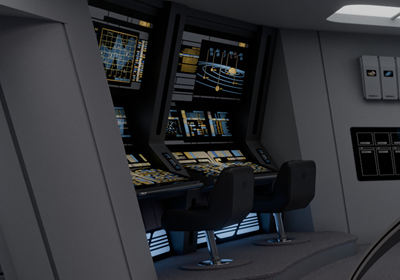
The Mission Operations station, commonly referred to as Mission Ops, is situated on the starboard side of the U.S.S. Voyager-C Bridge, positioned closest to the primary exit leading to the Captain’s Ready Room. This station serves as a critical extension of the Operations department, specifically designed to manage the complexities of the ship’s diverse secondary mission profiles. By acting as a high-level assistant to the Operations Manager, the Mission Ops officer is responsible for overseeing lower-priority tasks and research projects, ensuring that the vessel's primary objectives are never compromised by the competing resource demands of ongoing scientific or diplomatic endeavors.The primary function of this station is the real-time monitoring of telemetry from Away Teams. Whether a landing party is conducting a first-contact survey or exploring a hazardous planetary surface, the Mission Ops console serves as the definitive link for all Tricorder data and mission-specific instrumentation. The officer at this station tracks the movement, health, and findings of personnel off-ship, coordinating with the Transporter Room and the primary Ops station to ensure seamless communication and support. During these assignments, Mission Ops can reconfigure and recalibrate sensor systems at a moment’s notice to provide the command team with specialized intelligence that might fall outside the scope of general-purpose scanning.
In Tactical or crisis situations, the role of Mission Ops shifts toward Bridge security and command support. The station coordinates closely with the Security and Tactical Officer, providing vital data on the location and status of secondary mission teams whose activities might impact shipwide safety or defensive strategies. Furthermore, the Mission Ops technician often serves as the relief Operations Manager, maintaining the ship’s resource allocation filters during shift rotations. By consolidating these logistical and telemetry-heavy tasks into a dedicated starboard hub, the Voyager-C ensures that even the most minute secondary details are monitored by a human operator, preventing departmental conflicts and maintaining operational focus during its long-range journey.
Science Station
The Science station on the U.S.S. Voyager-C is the primary hub for deep-space research, sensor analysis, and stellar investigation. Located on the starboard bulkhead to the right of the Mission Ops console, this station serves as a specialized command node that allows Science Officers and Mission Specialists to coordinate directly with the Bridge staff. While the ship maintains extensive laboratories on lower decks, this Bridge station is essential when the vessel's positioning or Tactical status must be precisely aligned with scientific observations. It provides the command team with real-time intelligence on planetary bodies, unusual stellar phenomena, and anomalous energy readings encountered during their long-range exploration.The workstation is a streamlined, wall-mounted console that mirrors the Engineering station's efficient design. It features a high-resolution primary display built into the bulkhead, supplemented by touch-sensitive LCARS interfaces that provide manual access to the ship’s vast scientific databases. A critical component of this station is the Sensor Calibration interface, which allows for the semi-automatic monitoring and recalibration of the ship’s long-range and lateral sensor arrays. Because even a minor inaccuracy in sensor telemetry could result in significant journey delays or tactical disadvantages, the science officer can reconfigure these systems at a moment’s notice to meet specific command intelligence requirements or primary mission profiles.
The console is designed for independent operation but can be linked to other Bridge stations, such as Ops or Mission Ops, to facilitate cooperative research. It acts as a Bridge-level command post for various internal departments, including Stellar Cartography and Exobiology, allowing for the rapid dissemination of data during Alert status. In such scenarios, the Science station can be granted priority access to the sensor arrays, overriding secondary shipboard studies to provide the Captain with immediate data for decision-making support.
Equipped with specialized Isolinear matrix panels, the station allows for the loading of mission-specific programs and the accumulation of large-volume observational data. It also incorporates a secondary X-Y translation pad and flight control overrides, ensuring that if the forward stations are compromised, the ship can still be piloted from this station to maintain a specific heading for scientific data collection. By integrating these powerful analytical tools into the starboard perimeter, the Voyager-C ensures that the pursuit of knowledge remains a central pillar of its mission, supported by the highest level of technical precision and human oversight.
Forward Section
Flight Control Station
The Flight Control station, or Conn, of the Voyager-C is the primary hub for the navigation and piloting of the spacecraft, situated in a shallow, sunken well directly in front of the command chairs. This strategic placement provides the Flight Control Officer with an unobstructed view of the viewscreen while maintaining a close physical link to the Captain and First Officer. Although the Intrepid II Class features a high degree of automation for course plotting and position verification, the criticality of the station's functions requires it to be manned at all times. From this console, the officer manages the ship’s heading, makes real-time course corrections, and monitors the status of the Warp and Impulse Engines, Reaction Control Thrusters, and Inertial Damping Systems.The Flight Controller acts as the permanent Bridge liaison to the Engineering Department, providing the Commanding Officers with essential data on propulsion system geometry and efficiency. During Warp travel, the station continually updates long-range sensor data to adjust for variations in the interstellar medium, while sublight flight requires constant monitoring of relativistic effects. In planetary orbit, the station becomes a vital resource for analyzing atmospheric conditions and managing shuttlecraft telemetry during launch and recovery. The console is equipped with five standard input modes, ranging from specific galactic coordinates to spacecraft intercept vectors, which allow the computer to calculate optimal flight paths based on safety protocols.
For high-stakes maneuvers, the console can be switched to full manual mode, allowing the officer to steer the ship under keypad control. A dedicated backup flight operations subprocessor and emergency navigation sensors ensure that the pilot maintains control even during severe systems failure. During combat or alert status, the Conn Officer works in total synergy with the adjacent Operations station and the Tactical Arch, accessing preprogrammed tactical maneuvers to defend the vessel while ensuring the ship's structural integrity remains within the permitted performance envelope.
Operations Station
The Operations Management station, or Ops, on the U.S.S. Voyager-C is the primary hub for coordinating shipboard resources and hardware, situated on the port side of the sunken forward deck. Positioned alongside the Flight Control station, the Ops console allows the Operations Manager to oversee the complex interplay between the ship's various departments. The station’s primary mandate is the resolution of conflicting requirements for power, sensor arrays, and computer processing. By serving as the human decision-maker in the resource-allocation loop, Ops ensures that mission goals are not jeopardized by mutually exclusive departmental needs, such as a high-priority science scan requiring the same lateral sensor array needed for navigational position verification.The workstation features a sophisticated interface that presents a continually updated list of major shipboard activities. While a majority of routine scheduling is handled automatically, the officer utilizes specific decision filters to intervene in unpredictable or high-stakes scenarios. During crisis situations or Reduced Power Mode, the Ops Officer works in close coordination with Main Engineering to manage load shedding and prioritize power for life support and defensive systems. The station is also responsible for providing general status information to the main computer, ensuring that every department is informed of anticipated changes that may affect their operations.
Beyond resource management, the Ops station is the nexus for mission logistics, including the coordination of away teams and shuttlecraft operations. The officer manages Transporter coordinates, assigns mission-specific equipment, and monitors away team telemetry. Additionally, the station oversees shuttlebay clearance and tracks auxiliary craft once they have cleared the ship. By integrating these wide-ranging responsibilities into a single forward-facing console, Voyager-C maintains a streamlined command structure that can rapidly adapt to the unique challenges of deep-space exploration.
Viewscreen
Occupying the majority of the forward bulkhead on Deck One, the Main Viewscreen of the Voyager-C serves as the primary visual interface for the Bridge crew, functioning much like a sophisticated "windshield" that allows the Senior Staff to observe the vessel’s flight path and surroundings. While it traditionally displays the output of the forward optical scanners, the screen is a highly versatile, multi-modal display matrix capable of projecting images from any of the ship’s external sensor arrays, regardless of their orientation. This allows the crew to maintain situational awareness in three-dimensional space by shifting the visual focus to the port, starboard, or aft perspectives at a moment's notice.The Viewscreen is constructed using an omni-holographic display matrix, enabling it to render complex data and three-dimensional information with high fidelity. A computerized heads-up display is often projected over the incoming visuals, providing the command team with real-time sensor readings and critical mission data germane to the ship's current status without obstructing the primary view. To facilitate rapid decision-making, this system is linked to a dedicated communications subprocessor, which permits near-instantaneous conversion of nearly any visual communications format, whether internal to the ship or transmitted from a distant alien vessel.
Beyond its role in Navigation and Tactical analysis, the Viewscreen is a central hub for the ship's diplomatic and exploratory functions. It acts as a shared workspace where the Captain, Conn, and Ops officers can simultaneously review Long-Range Sensor data, holographic starcharts, or incoming visual hailing frequencies for ease of contact. Because the Viewscreen is a critical component of Bridge operations, its hardware is integrated directly into the Bridge shell’s armored forward bay, which houses dedicated computer subprocessors to ensure the display remains operational even during significant system failures or high-intensity combat scenarios.
Port Section
Engineering Station
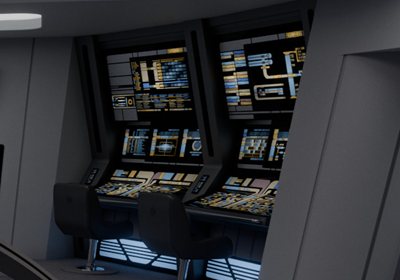
The Engineering station on the U.S.S. Voyager-C serves as the secondary command node for the ship’s vital propulsion and power systems. Mounted directly to the port bulkhead, this station is positioned with the Environment station and provides the Chief Engineer with a centralized platform to maintain full-spectrum supervision over the ship’s health while on the Bridge. While primary management of the Warp Core and power distribution occurs in Main Engineering, this station remains a critical asset for the command team during high-stakes missions or diplomatic encounters that require the Chief Engineer’s immediate presence at the Bridge level. Under routine Cruise Mode, the console typically operates in a passive display mode, serving as a high-level diagnostic monitor for the vessel's energy output.The workstation consists of a sophisticated array of flush, wall-mounted monitors and touch-sensitive LCARS interfaces. Unlike the wraparound alcoves of earlier designs, this streamlined configuration provides a clean, space-efficient interface that delivers detailed telemetry on the Warp and Impulse propulsion Systems, as well as the shipwide power grid. A primary feature of this station is its role as an emergency fail-safe; if Main Engineering becomes inaccessible or must be evacuated due to hazardous systems failure, the Bridge station can be placed into Full Enable Mode. From here, personnel can access the Bridge’s Engineering sub-processor to manually override flight operations, plot courses via an X-Y translation pad, and even initiate a warp core ejection — a final measure that is often impossible to perform from Engineering itself during a catastrophic event.
For maximum operational resilience, the Engineering station is linked to the ship's propulsion hardware via dedicated optical hardlines in addition to the standard optical data network (ODN). This redundancy ensures that even if the primary computer cores are compromised or the gel pack processing network suffers a localized failure, the station can maintain direct manual control over every servo and primary propulsion system. By consolidating these high-level technical controls into a single wall-mounted hub, the Voyager-C ensures that the Chief Engineer can pivot from passive observation to active emergency management without delay, maintaining the ship's survival in the unpredictable conditions of deep space.
Environment Station
The Environment station on the U.S.S. Voyager-C is the primary hub for monitoring and controlling the vessel's comprehensive life support systems. Located on the port bulkhead next to the Engineering workstation, this console serves as a vital safeguard for the ship’s internal habitat. Although the station is often left in a passive, automated mode during routine Cruise Mode operations, its role is of critical importance during alert and crisis situations. The console is programmed to provide real-time telemetry on atmospheric composition, ambient temperature, artificial gravity, and inertial damping, while also monitoring the integrity of the ship's internal dampening subsystems.Beyond atmosphere management, the station oversees the vital consumables and recycling systems essential for long-range missions. The Environment officer, or sophisticated automation subroutines, tracks the levels and purity of oxygen and water inventories, ensuring that the reprocessing systems are operating at peak efficiency to maintain a continuous supply of food and other essentials. If an anomaly is detected while the station is unattended, the system immediately alerts the Operations Manager, providing a detailed analysis of the discrepancy and suggesting corrective protocols to restore nominal conditions.
During Yellow or Red Alert scenarios, the Environment station functions as a deputy to the Operations station, specifically focused on maximizing crew survivability. The duty officer is responsible for executing survival scenarios, such as the evacuation of personnel to designated environmental shelter areas and is authorized to reallocate life support resources to damaged decks or critical compartments. By consolidating these life-sustaining functions into a dedicated workstation, the Voyager-C ensures that the delicate balance of the ship's internal ecosystem is maintained, providing the crew with a stable and safe environment even under the extreme pressures of deep-space exploration.
Captain's Ready Room
 The Captain’s Ready Room on the U.S.S. Voyager-C serves as the primary administrative hub and private sanctuary for the vessel's Commanding Officer. Strategically located on Deck 1, this spacious office is situated directly behind the Main Bridge and provides an immediate connection to the Executive Briefing Room. This proximity ensures that the Commanding Officer can maintain near-instant access to the Bridge during a crisis while having a secure, separated area to handle sensitive personnel matters, study classified mission reports, or receive secure subspace communications.
The architectural design of the room utilizes a split-level floor plan that creates distinct zones for work and relaxation. Upon entering through the sliding doors from the Bridge, the primary focal point is the Captain’s desk, situated on a slightly elevated platform. This curved desk features a high-performance integrated LCARS terminal capable of processing complex sensor data and supplementary holographic projections. Directly behind the desk, a recessed hexagonal shelf built into the bulkhead allows for the display of personal artifacts and historical mementos. Two guest chairs are positioned in front of the desk to accommodate senior staff or visiting dignitaries during private consultations.
The lower section of the room is dedicated to an informal sitting area, dominated by three large, deck-height windows that look out toward the rear of the starship. A large, curved sofa is nestled directly beneath these windows, offering a panoramic view of the nacelles and the starfield beyond. This area is serviced by a built-in food replicator and a sleek, circular coffee table, facilitating informal discussions or moments of quiet reflection. Throughout the space, the decor reflects the unique history of the Intrepid II Class, blending luxury and function. From the warm ambient lighting to the specialized computer interfaces, the Ready Room is designed to support the intense demands placed upon a Starfleet commander during a deep space mission of exploration.
Executive Conference Room
 The Executive Conference Room on the U.S.S. Voyager-C serves as the vital nerve center for senior staff deliberations and strategic mission planning. Located on the aft section of Deck 1, this room provides a more intimate and focused environment than the larger briefing rooms found on explorer type starships, yet it maintains all the high-level functional requirements of a top-tier exploratory vessel. The room is cleverly positioned to act as a bridge between the ship’s primary command and administrative centers, featuring a direct connection to the Captain's Ready Room on the starboard side, while a port-side alcove leads through a short corridor back to the Bridge.
The centerpiece of the Executive Conference Room is a large briefing table designed to accommodate the ship’s senior officers. Positioned around this table are at least seven high-backed, padded chairs that provide necessary ergonomic support for long-duration briefing sessions. By tradition, the Commanding Officer sits at the head of the table, directly beneath a trio of expansive aft-facing windows. These view ports offer an impressive, unobstructed view of the starship’s rear superstructure and Warp Nacelles, providing a constant visual reminder of the vessel’s status and the deep space through which it travels.
Technological integration is seamless throughout the space. Embedded in the aft bulkhead is a large computer display monitor, which acts as the primary visual aid during briefings. This screen can display real-time tactical overlays, systems integrity scans, and subspace communications, ensuring that all attendees are fully informed of mission-critical data. Supplementing this is a holographic projector built into the briefing table, allowing for three-dimensional visualizations of planetary systems or tactical maneuvers. To ensure the comfort of the crew during extended meetings, a dedicated replicator is integrated into the port alcove, allowing officers to access refreshments without leaving the secure area. The room is finished with sound-absorbing panels and subtle touches of personality, including historical mementos and curated artwork that reflect the legacy and spirit of the Voyager-C and its crew.
Categories: No categories found