Project Pathfinder
Created by Captain Maohl Johrend on Tue Jul 7th, 2026 @ 5:07pm
History
Mission Overview
Deployment Force Composition
Project Pathfinder Flagship
U.S.S. Gora bim Gral NCC-125401
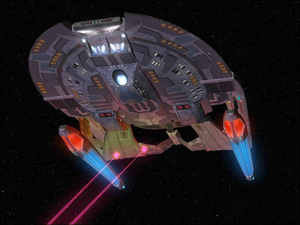 Commissioned during President Qorjodob’s sweeping post-Borg naval modernization initiative, the U.S.S. Gora bim Gral stands as a monument to international cooperation and multi-species engineering. Named in honor of the legendary Tellarite diplomat who helped forge the Federation's founding coalition, this Ra-ghoratreii Class Heavy Explorer was designed specifically to project stability and strength along the outer-rim frontiers.
The ship’s early years were defined by intense crew certifications within the Sol System, where its structural systems were routinely targeted by Typhon Pact saboteurs eager to intercept next-generation Starfleet tactical data. Following the stabilization of the frontier under the Enhanced Khitomer Accords, the Gora bim Gral was permanently assigned as the spearhead of the Delta Quadrant Task Force. Equipped with advanced long-range sensor arrays, multi-spatial shielding, and a highly integrated diplomatic suite, the flagship serves as a mobile command base capable of operating for years away from traditional Starfleet support networks. As the sovereign vanguard of the task force, the Gora bim Gral carries the Federation's renewed mandate of exploration, peaceful diplomacy, and defensive vigilance back into the deep frontier of the Delta Quadrant.
Project Pathfinder Defense Squadron
U.S.S. Buran NCC-123118
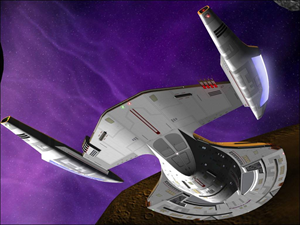 The U.S.S. Buran carries a lineage of resilience, named after the historic Starfleet vessels that stood the line at the binary star system and during the brutal conflicts of the 23rd and 24th centuries. Laid down at the San Francisco Fleet Yards during the height of the Gaxal Emergency, construction of the Buran was severely delayed by Orion Syndicate resource strikes on Capella IV. However, following the enactment of the Frontier Autonomy Act of 2434, its blueprint and construction assets were decentralized to peripheral facilities, allowing the starship to be rapidly completed and up-armored.
Built as an Intrepid II Class Exploratory Cruiser, the Buran represents a perfect fusion of structural durability and tactical adaptability. During the tense days of the Tzenkethi and Tholian border lockdowns, the Buran served as a critical frontline picket ship, successfully repelling asymmetric proxy raids along the Nixxel border. Its reinforced hull geometry and advanced shield distribution networks make it the ideal anchor for the Defensive Squadron. Within the task force, the Buran is tasked with establishing secure operational perimeters, executing threat-containment maneuvers, and ensuring the physical preservation of the exploratory vessels during deep-space operations.
U.S.S. Constance NCC-124902
 The U.S.S. Constance was built as a direct answer to the terrifying tactical paradigm shifts of the early 2430s. As the Typhon Pact began integrating salvaged Borg tech into their active ship-production pipelines, Starfleet required a hyper-focused, heavily armed interceptor capable of breaking through reinforced shield grids. The Constance served as a primary strategic proof-of-concept at the Bajoran Okana Shipyards, paving the way for a new generation of frontline escorts.
Armed with high-yield quantum torpedo launchers and pulse-phaser banks, the Constance proved its mettle during the volatile border disputes of 2436. It was deployed to intercept rogue Klingon traditionalist factions executing live-fire drills near Ferengi shipping routes. The vessel's compact frame is packed with localized structural integrity fields and high-output impulse engines, enabling unmatched maneuverability in close-quarters skirmishes. As part of the Defensive Squadron, the Constance provides rapid-response capabilities, aggressively interposing itself between hostile capital ships and the task force’s utility vessels, ensuring that any external aggression is met with overwhelming defensive counter-fire.
U.S.S. T'Shen Kovil NCC-123895
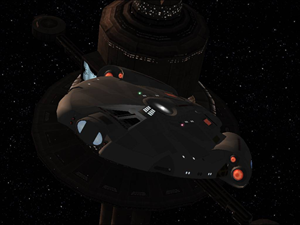 The U.S.S. T'Shen Kovil was commissioned into service as a specialized scout and electronic warfare platform under the classified "Sentinel Protocol" frameworks originally established to combat deep-tissue espionage. As a Sentinel Class Light Escort, the starship trades heavy capital-grade weaponry for enhanced sensor baffling, long-range tachyon detection grids, and multi-spectral communication jamming suites.
Named after a prominent Vulcan logic sanctuary, the T'Shen Kovil spent its early deployments patrolling the perimeter of the Pleiades Quarantine Zone. There, it monitored the residual temporal wakes and chronometric distortions left behind by historical incursions, ensuring that Typhon Pact scavengers could not infiltrate the restricted sector. The vessel's unique design allows it to run under a drastically reduced energy signature, making it virtually invisible to standard long-range telemetry. For the Delta Quadrant Task Force, the T'Shen Kovil acts as a forward screen for the Defensive Squadron. It is responsible for charting safe passage through hazardous stellar phenomena, detecting cloaked threats, and deploying active electronic countermeasures to blind potential adversaries before combat begins.
U.S.S. Righteous NCC-125114
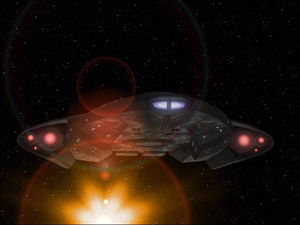 The U.S.S. Righteous proudly claims one of the most unique legacy names in the fleet, inheriting its registry from the original 24th-century starship that was famously pulled from the Battle of Wolf 359 by the entity Q. This modern iteration, a Valiant Class Escort, was built under the strict defense mandates of the Alval administration to serve as a high-speed deterrent against privateer incursions.
Launched from the Okana Shipyards, the Righteous was immediately thrown into the lawless borderlands to combat displaced Orion and Nausicaan privateer networks fleeing Klingon pacification campaigns. In 2437, the Righteous operated alongside the U.S.S. Robinson to enforce the tense blockade of the Nixxel Convention, standing face-to-face against automated Tzenkethi weapon platforms. The starship’s systems are streamlined for maximum combat efficiency, utilizing a specialized weapons-matrix that can cycle power directly from non-essential sub-systems during high-intensity engagements. Within the Delta Quadrant Task Force, the Righteous acts as a flanking interceptor, utilizing its speed and lethal payload to break up hostile formations before they can threaten the flagship.
U.S.S. Thy'lek Shran NCC-124230
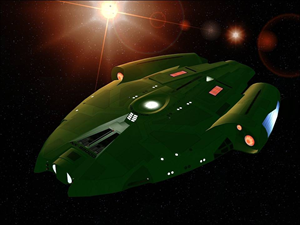 Named in honor of Andoria’s legendary Imperial Guard Commander, the U.S.S. Thy'lek Shran embodies the fierce independence and tactical stubbornness of its namesake. Built in the wake of the Andorian Meta-Genome crisis and subsequent political revitalization, the Thy'lek Shran was constructed using regional resources secured under the Frontier Autonomy Act.
This Sentinel Class Light Escort was heavily modified by Andorian engineers, who integrated localized hive-mind processing networks and rapid-cycling phaser emitters to counter the automated "Ghost Warbirds" deployed along the Romulan border. The Thy'lek Shran earned structural honors during the 2436 standoff at Unity Station, where its crew assisted in isolating the distinct subspace signatures of stolen Federation stealth hardware, preventing a complete diplomatic collapse of the Khitomer Accords. Now deployed as a critical asset within the Defensive Squadron, the Thy'lek Shran provides rapid point-defense capabilities. It excels at hunting down micro-targets, intercepting incoming torpedo salvos, and executing aggressive compliance maneuvers against any asymmetric forces that attempt to compromise the task force's perimeter.
Project Pathfinder Exploratory Squadron
U.S.S. Chesley Bonestell NCC-122540
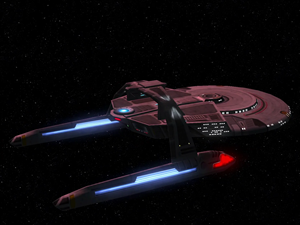 The U.S.S. Chesley Bonestell is a rugged Miranda IV Class Utility Vessel, a design class that remains the absolute backbone of Starfleet's logistical, transport, and support networks. Named after the visionary terrestrial artist who helped humanity visualize the beauty of the cosmos before the dawn of warp travel, the Chesley Bonestell was built to survive the harshest operating conditions the frontier can offer.
The Miranda IV configuration features an expanded internal cargo bay, heavy-duty tractor beam emitters, and mobile industrial replicator matrices. During the massive economic reconstruction projects initiated under the Benzite Doctrine, the Chesley Bonestell was instrumental in delivering vital raw materials and terraforming equipment to the devastated worlds of the Demilitarized Zone. Within the Exploratory Squadron, the vessel ensures structural and operational continuity for the entire fleet. It is responsible for transporting critical fuel reserves, executing field repairs on damaged escorts, and establishing planetary transport networks. The Chesley Bonestell is a testament to the philosophy that no exploration mission can succeed without uncompromised logistics.
U.S.S. Melbourne NCC-109355
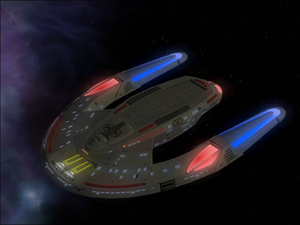 The U.S.S. Melbourne is a Gol Class Light Cruiser specifically engineered for deep-space cartography and comprehensive planetary evaluation. Named after the terrestrial city that stood as a symbol of reconstruction and resilience, the Melbourne was built to replace the aging light cruisers lost during the catastrophic multi-front conflicts of the late 2390s and early 2400s.
The Melbourne features an expanded secondary sensor array and a specialized, modular laboratory deck capable of being reconfigured for exotic biological, temporal, or astrophysical research. During the geopolitical crises of the 2430s, the Melbourne was routinely deployed to monitor the unstable subspatial fault lines left behind by rogue Coaxial Warp Drive testing and quantum singularity anomalies. Its structural design prioritizes high-efficiency cruising speeds and precise orbital stabilization. Within the Exploratory Squadron, the Melbourne acts as the primary scientific workhorse. It is deployed to execute detailed scans of newly discovered worlds, analyze rich dilithium veins, and investigate ancient archaeological anomalies, providing the task force with the deep technical intelligence required to secure safe resource lanes in the frontier.
U.S.S. Seleya NCC-109780
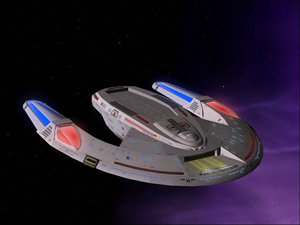 Named after the sacred mountain of Vulcan, the U.S.S. Seleya is a Gol Class Light Cruiser that reflects the precise, analytical discipline of its namesake. The ship’s construction was overseen by specialized teams from the Vulcan Science Academy, who outfitted the vessel with advanced long-range telemetric suites and highly sensitive subspace resonance scanners.
Following the public unmasking of the True Way infiltration and the subsequent reorganization of Starfleet Intelligence, the Seleya was used to map and monitor the highly volatile subspatial rifts created during the Borg-Undine wars. The Seleya’s crews are renowned for their expertise in anomalous physics and stellar evolution. Assigned to the Exploratory Squadron of the Delta Quadrant Task Force, the Seleya serves as the eyes of the fleet. It operates on the perimeter of known sectors, utilizing its powerful deflector-mounted sensor arrays to pierce through dense nebulae, map unstable gravimetric fields, and detect deep-space hazards weeks before the main task force arrives, ensuring the absolute safety of the fleet's trajectory.
U.S.S. ibn Sina NCC-122912
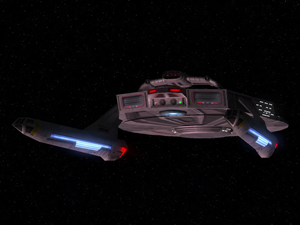 Named after the ancient Persian philosopher and physician who pioneered modern medical science, the U.S.S. ibn Sina serves as the premier medical and biological research sanctuary for the Delta Quadrant Task Force. As a Miranda IV Class Utility Vessel, its standard modular hull space was entirely hollowed out during construction to accommodate a massive, state-of-the-art bio-containment facility, multiple intensive care wards, and advanced triage bays.
The ibn Sina inherits a legacy of intense humanitarian defiance; its design lineage dates back to the medical teams who risked total execution to synthesize and distribute the Andorian Meta-Genome reproductive cure past Gaxal’s blockades. Equipped with custom micro-power cell shield generators and advanced synaptic transceivers, the ibn Sina can isolate and neutralize volatile pathogens before they infect a starship's primary life-support loops. Deployed within the Exploratory Squadron, the ibn Sina is responsible for safeguarding the health of the task force’s personnel, conducting xenobiological analyses of newly encountered lifeforms, and providing rapid medical relief to frontier worlds suffering from biological isolation.
U.S.S. Sonak NCC-126104
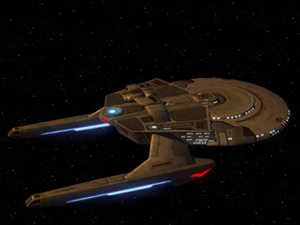 The U.S.S. Sonak is a Miranda IV Class Utility Vessel optimized for heavy structural engineering, orbital construction, and deep-space fleet maintenance. Named in memory of the dedicated Vulcan officer who tragically lost his life during the refit era of the original U.S.S. Enterprise, the Sonak embodies the precision and dedication required to keep a fleet operational behind enemy lines.
Equipped with a massive external fabrication frame, specialized multi-phasic structural welders, and an elite complement of the Starfleet Engineering Corps, the Sonak was a vital asset during the rapid, desperate rebuilding of Deep Space Nine. Its crew specialized in dismantling decommissioned assets and seamlessly integrating alien components into active starship hulls. Within the Exploratory Squadron, the Sonak serves as a mobile shipyard. It is capable of stabilizing fractured spaceframes, clearing power-grid cascades, and managing software patches for experimental propulsion units under field conditions. Without the Sonak, the task force would be forced to retreat to distant starbases for routine maintenance, making it an indispensable asset for deep-space longevity.
U.S.S. Leo Tolstoy NCC-126744
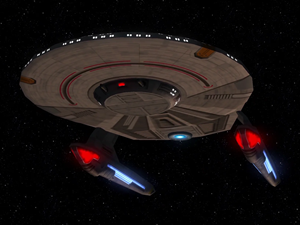 The U.S.S. Leo Tolstoy is a Miranda IV-class Utility Vessel configured as a high-capacity communications relay and data-archiving platform. Named after the classic terrestrial author who masterfully detailed the massive, sweeping movements of history and human conflict, the Leo Tolstoy is tasked with ensuring that the Delta Quadrant Task Force remains connected to the heart of the Federation across thousands of light-years.
The vessel features a heavily reinforced subspatial communications matrix and specialized data vaults designed to withstand severe chronokinetic distortions and cybernetic infiltration attempts. During the dark periods of the Gaxal and Section 47 crises, when primary communication lines were deeply compromised, vessels of this configuration utilized isolated legacy data chips and decentralized networks to securely transmit vital tactical logs past corrupted relays. Within the Exploratory Squadron, the Leo Tolstoy manages the task force’s telemetry streams, translates complex alien linguistic matrices, and maintains the historical logs of all first-contact protocols, ensuring that every discovery is safely recorded for the annals of Starfleet history.
U.S.S. Voyager NCC-74656-C
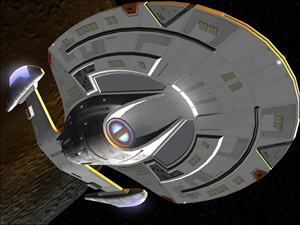 No name carries greater weight in the history of the Delta Quadrant than Voyager. The U.S.S. Voyager-C, an Intrepid II Class Exploratory Cruiser, represents the pinnacle of deep-space survival and autonomous long-range operations. Built to honor the historic legacy of Admiral Janeway’s original pathfinder vessel, the Voyager-C was constructed following the formalization of the Enhanced Khitomer Accords to push the boundaries of known space once again.
The vessel features a state-of-the-art bio-neural computer core, advanced astrometrics systems, and a fully integrated holographic environment designed to support long-term crew morale during extended deep-space traversals. Before its assignment to the task force, the Voyager-C completed a series of high-stakes diplomatic missions along the Gamma Quadrant frontier, ensuring compliance with the historic Dominion treaties. As the spiritual and operational lead of the Exploratory Squadron, the Voyager-C is tasked with charting unexplored star systems, establishing formal contact with new civilizations, and compiling vast stellar databases. Under the disciplined guidance of seasoned leadership, this formidable vessel continues to embody Starfleet's highest ideals. It is a ship built to withstand the isolation of the deep frontier, carrying the Federation's enduring spirit of curiosity back into the quadrant that defined its lineage.
Categories: No categories found