Legacy
Created by Captain Maohl Johrend on Wed Apr 8th, 2026 @ 11:31am
Sea-going Vessels
| Affiliation: | France |
| Class: | Schooner |
| Service Period: | 1811 - 1813 |
| Fate: | Lost at Sea |
Voyageur
Launched during the height of the Napoleonic Wars, the Voyageur was a French privateer schooner that epitomized the daring maritime spirit of the early 19th century. Commissioned in 1811, the vessel was designed for speed and agility, featuring a sleek hull and a raked mast configuration that allowed it to outmaneuver the heavier, more cumbersome warships of the British Royal Navy. Operating primarily out of the Caribbean and the Atlantic coast, the Voyageur served as a commerce raider, tasked with disrupting enemy supply lines and capturing merchant prizes to bolster the French war effort.The ship’s crew consisted of a multinational assembly of sailors and adventurers, many of whom were drawn to the vessel by the promise of prize money and the ship's reputation for slipping through naval blockades. Throughout its brief but active career, the Voyageur became a phantom of the high seas, frequently utilizing the shallow coastal waters of the Antilles to evade capture. Its tactical successes provided a vital, if localized, challenge to British naval hegemony during a period of global upheaval.
Though the vessel was eventually lost to the elements during a severe tropical gale in the autumn of 1813, its legacy endured in maritime lore. The Voyageur remained a symbol of independent naval enterprise and the strategic importance of fast, light-draft vessels in the era of sail. Its name, French for "Traveler," underscored a legacy of crossing vast distances under the constant threat of pursuit, long before the advent of modern industrial warfare.
 | |
| Affiliation: | United Kingdom |
| Class: | W Class Destroyer |
| Service Period: | 1918 - 1933 |
| Fate: | Transferred |
HMS Voyager
The HMS Voyager was commissioned in the final months of the Great War, representing the cutting edge of British destroyer design as a member of the V and W classes. Launched in 1918 from the Swan Hunter shipyards, the vessel was built to provide high-speed escort and a potent torpedo threat against the emerging submarine and surface challenges of the early twentieth century. With its distinctive raked funnels and a reinforced hull capable of weathering the volatile conditions of the North Sea, the ship entered service just as the global conflict reached its weary conclusion. Though it arrived too late to participate in the massive fleet engagements that defined the era, the destroyer immediately transitioned into the complex post-war maritime landscape, where it served as a symbol of the Royal Navy’s continued policing of the seas.During the interwar period, the vessel was a mainstay of the Atlantic and Mediterranean fleets, participating in extensive exercises that refined the tactics of modern destroyer warfare. Life aboard the ship was defined by the transition from coal to oil and the increasing reliance on radio and early sonar technology, marking the ship as a bridge between the traditions of the Victorian navy and the industrial demands of a new age. The destroyer’s British service came to a close in 1933 when it was transferred to the Royal Australian Navy. This move began a secondary chapter for the ship, as it shed its British identity to become a cornerstone of Australian maritime defense. Through this transition, the vessel carried forward a legacy of reliability and versatility that would eventually lead it into the most intense theaters of the following global conflict.
 | |
| Affiliation: | United States of America |
| Class: | Motorboat |
| Service Period: | 1917 - 1936 |
| Fate: | Scrapped |
U.S.S. Voyager (SP-361)
The USS Voyager (SP-361) entered service during the mobilization of the United States for the Great War, representing the diverse fleet of civilian craft pressed into military duty. Originally built as a private motorboat, the vessel was acquired by the Navy in 1917 to bolster coastal defenses and harbor security. Constructed with a wooden hull and designed for maneuverability rather than heavy engagement, the ship was quickly outfitted with light armament to fulfill its new role as a patrol craft. Stationed primarily in the Great Lakes region, specifically near the vital locks of Sault Ste. Marie, the vessel was tasked with protecting essential industrial shipping lanes and infrastructure from potential sabotage or internal threats during the height of the conflict.The ship’s service was defined by the relentless, unglamorous work of maritime surveillance, navigating the temperamental freshwater currents to ensure the steady flow of iron ore and grain to the Atlantic coast. Though it never faced the thunder of dreadnought cannons, the vessel served as a critical link in the domestic security chain that supported the broader American war effort. Following the signing of the Armistice, the Navy determined that the small patrol craft was no longer a strategic necessity for the frontline fleet. In 1919, the vessel was transferred to the United States Coast Guard, where it began a second career as a harbor cutter. Operating out of Chicago, it continued to serve as a watchful presence on the American waterfront well into the 1930s, eventually being retired as a relic of the era when private leisure craft were transformed into the sentinels of a nation at war.
| |
| Affiliation: | Commonwealth of Australia |
| Class: | W Class Destroyer |
| Service Period: | 1933 - 1942 |
| Fate: | Scuttled |
HMAS Voyager (D31)
Commissioned into the Royal Australian Navy in 1933, the HMAS Voyager began its service as part of a specialized destroyer flotilla transferred from British to Australian command. A veteran of the Great War design era, the vessel was affectionately nicknamed part of the "Scrap Iron Flotilla" by Axis propaganda due to its age and weathered appearance. Despite these dismissive labels, the ship proved to be a formidable and tireless combatant during the early years of the Second World War. Operating primarily in the Mediterranean, the destroyer participated in the critical evacuations of Greece and Crete, braving relentless aerial bombardment to rescue thousands of Allied troops from the advancing enemy forces.The ship’s reputation for resilience was forged in the heat of the "Tobruk Ferry Service," where it made high-speed nocturnal runs to resupply the besieged Australian garrison in North Africa. Navigating through minefields and submarine-infested waters, the vessel became a lifeline for the ground forces, embodying the scrappy and defiant spirit of the Australian maritime effort. Following its intense Mediterranean service, the destroyer was reassigned to the Pacific theater as the threat of Japanese expansion loomed over the Australian continent.
In late 1942, while attempting to land independent company troops on the coast of Japanese-occupied Timor, the vessel ran aground during a difficult night maneuver. Stranded on the shoreline and battered by Japanese bombers the following day, the ship was eventually scuttled by its own crew to prevent its advanced telegraphic equipment and armament from falling into enemy hands. The loss of the vessel marked the end of a decorated career that spanned two oceans and two decades of global upheaval.
 | |
| Affiliation: | Commonwealth of Australia |
| Class: | Daring |
| Service Period: | 1957 - 1964 |
| Fate: | Sunk |
HMAS Voyager (D04)
The HMAS Voyager (D04) was a Daring-class destroyer commissioned in 1957, representing the pinnacle of Australian naval engineering during the early Cold War. Built at the Cockatoo Island Dockyard in Sydney, the vessel was designed for high-speed versatility, equipped with advanced radar suites and rapid-fire weaponry intended for anti-aircraft and anti-submarine operations. As a symbol of a modernizing Royal Australian Navy, the ship spent much of its early career conducting diplomatic "show the flag" cruises and rigorous multi-national exercises across the Pacific and Indian Oceans, embodying the transition from the rugged aesthetics of World War II to the sleek, electronic-focused doctrines of the mid-twentieth century.The ship’s legacy, however, remains forever defined by the night of February 10, 1964, during a series of post-refit sea trials off the coast of New South Wales. While performing maneuvers with the aircraft carrier HMAS Melbourne, the Voyager unexpectedly turned across the carrier's bows. The much larger flagship, unable to stop or turn in time, struck the destroyer amidships, slicing the vessel in two. The forward section sank almost immediately, while the aft section remained afloat for several hours, allowing for harrowing rescue efforts in the darkness.
The disaster resulted in the loss of eighty-two officers and men, marking the greatest peacetime tragedy in the history of the Australian military. The subsequent investigations and Royal Commissions into the collision fundamentally altered Australian naval protocol, leading to permanent changes in command responsibility and safety procedures. Today, the name remains a solemn point of reflection, honored by annual memorials that recognize the ship not just for the tragedy of its end, but for the dedicated service of the crew who maintained the watch during a transformative era of maritime history.
Spacecraft
 | |
| Affiliation: | United States of America |
| Class: | Space Probe |
| Service Period: | 1977 - 2273 |
| Fate: | Decommissioned |
Voyager Space Probe Program
The Voyager Space Probe Program stands as the most ambitious endeavor of the late 20th century, a series of robotic explorers designed to traverse the outer solar system and eventually bridge the gap into interstellar space. Initiated by NASA in the early 1970s, the program leveraged a rare alignment occurring once every 175 years, allowing spacecraft to utilize gravitational assists to move from one planet to the next. What began as a mission to the gas giants evolved into a multi-generational legacy of discovery, with each successive probe pushing the boundaries of human knowledge and technological endurance.Voyager 1 and Voyager 2, launched in 1977, provided the first high-resolution glimpses of the Jovian and Saturnian systems, revealing active volcanism on Io and the complex structure of Saturn's rings. Both carried the Golden Record, a phonograph containing the sights and sounds of Earth, intended as a message for any celestial intelligence that might encounter the craft in the distant future. The program’s expansion continued with Voyager 3, 4, and 5, which conducted longitudinal studies of the outer planets' magnetospheres and the heliopause, the boundary where the sun’s influence gives way to the interstellar medium.
The program culminated in the launch of Voyager 6, an advanced probe equipped with experimental sensor arrays designed to "learn all that is learnable" and return that data to its creator. However, shortly after its launch, the craft disappeared into a massive gravitational anomaly near the edge of the solar system, losing all contact with Earth. Centuries later, this lost explorer would be transformed by an alien machine race into a vast, sentient power known as V’Ger. Seeking its creator, the entity returned to Earth enveloped in a massive cloud of energy, nearly destroying the Federation’s homeworld before evolving into a new form of life through a physical union with a human crew member. This event remains the most significant and dangerous contact ever initiated by a relic of 20th-century Earth.
 | |
| Affiliation: | United Earth United Federation of Planets |
| Class: | NV |
| Service Period: | 2153 - 2175 |
| Complement: | 46 Officers and Enlisted |
| Fate: | Museum |
U.S.S. Voyager NV-05
The Voyager (NV-05) was a pioneering achievement of United Earth Starfleet, commissioned in the early 22nd century during the formative years of deep-space exploration. As a contemporary of the famous Neptune-class and the early Warp Delta designs, the vessel was built to test the endurance of human crews and the reliability of early warp drive systems before the development of the United Federation of Planets. With a hull composed of reinforced duranium and an interior layout that prioritized functional utility over comfort, the ship served as a mobile laboratory and scout, tasked with pushing the boundaries of Sol’s neighboring star systems and establishing the first reliable navigational charts of the "local bubble."The ship’s service was defined by the transition from short-range interplanetary hops to true interstellar travel, operating at a time when Earth was still finding its footing among more advanced species like the Vulcans and Denobulans. During its primary tenure, the NV-05 was instrumental in several "first contact" scenarios with non-aligned species, often serving as the primary diplomatic platform for United Earth representatives. The crew faced the immense isolation of early warp travel without the benefit of a vast starbase network, relying on their own ingenuity to repair systems and navigate the unknown reaches of the Alpha Quadrant.
Though eventually eclipsed by the faster, more advanced NX-class and the subsequent expansion of the fleet, the Voyager (NV-05) remained a symbol of Earth's independent resolve. It represented a generation of explorers who ventured into the dark with primitive sensors and limited shielding, laying the groundwork for the era of peaceful cooperation that would follow. The vessel was eventually retired and preserved as a historical landmark, serving as a testament to the era when humanity first truly began to call the stars its home.
 | |
| Affiliation: | United Federation of Planets |
| Class: | Einstein |
| Service Period: | 2234 - 2284 |
| Complement: | 800 Officers and Enlisted |
| Fate: | Scrapped |
U.S.S. Voyager NCC-656
The U.S.S. Voyager (NCC-656) was a distinguished Einstein Class starship that served as a cornerstone of Starfleet’s exploratory wing during the mid-23rd century. Characterized by its unique single-nacelle design mounted beneath a rugged, circular primary hull, the vessel was a specialized scout and science platform built for high-endurance missions in deep space. While the heavy cruisers of the era handled the complexities of Klingon border diplomacy, the Voyager operated in the relative silence of the frontier, utilizing its advanced sensor suites to conduct meticulous planetary classifications and long-duration stellar surveys.The ship’s most significant contribution to navigational history occurred during its survey of the Mempa Sector, where its crew mapped a series of volatile subspace corridors that would later become vital supply routes for the Federation. Despite its scientific mandate, the Einstein Class was built with a sturdy frame that allowed the 656 to maintain tactical readiness during the brief Federation-Klingon War. Its specialized arrays proved invaluable for detecting obscured threats in high-interference environments, earning the crew a reputation for technical ingenuity. They were known for pushing their sensors to the absolute limit, achieving resolution levels that rivaled much larger, multi-mission vessels.
The Voyager remained in active service well into the late 2280s, its reliable spaceframe eventually serving as a bridge to the more modern modular designs of the Excelsior era. Upon its decommissioning, the ship was stripped of its classified reconnaissance tech and repurposed as a static training hull at Starfleet Academy. There, generations of cadets learned the fundamentals of warp mechanics and sensor operations on its aging but dependable systems. Its legacy is one of quiet, steadfast reliability — a workhorse of the fleet that proved the Voyager name was synonymous with the endurance and precision required to chart the unknown reaches of the galaxy.
 | |
| Affiliation: | United Federation of Planets |
| Class: | Prospero |
| Service Period: | 2291 - 2358 |
| Complement: | 500 Officers and Enlisted |
| Fate: | Destroyed |
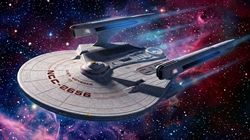
U.S.S. Voyager NCC-2656
The U.S.S. Voyager (NCC-2656) was a member of the Prospero Class, commissioned in 2291 during the twilight of the Constitution era and the dawn of the Excelsior hegemony. Designed as a specialized alternative to heavier cruiser frameworks, the Prospero class utilized a radical structural layout, mounting its twin Warp Nacelles high above the primary hull on a swept pylon assembly and slinging its vital secondary systems into a low-profile, ventral equipment pod. This configuration balanced the raw power of its oversized Impulse Engines with the immense fuel and sensor capacity required for multi-year deep-space assignments. While contemporary ships like the Titan became the high-profile faces of Federation diplomacy, the Voyager operated as the fleet's quiet pioneer, tasked with pushing into the "Zone of Silence" along the perilous Beta Quadrant frontier.For nearly seven decades, the Voyager served with distinction as a premier long-range explorer and tactical surveyor. Its internal architecture was exceptionally advanced for the late 23rd century with the Prospero being the first Starfleet design to incorporate a modular mission pod. This versatility was put to the test during the Great Awakening of 2309, where the ship’s specialized scanners were instrumental in mapping the subspace fractures that threatened several fledgling colonies. The vessel became a highly coveted posting for rising officers who sought a balance of scientific rigor and tactical readiness, fostering a legendary culture of "practical engineering" that saw the sleek ship consistently outpace and outperform newer, larger classes.
The Voyager’s long and decorated service met a tragic yet heroic end in 2358 during the height of the Federation-Cardassian War. While providing a critical defensive screen for a retreating medical convoy near the McAllister C-5 Nebula, the ship was intercepted by a superior Cardassian task force. Despite its age, the Voyager leveraged its high-mounted nacelle dynamics and superior impulse maneuverability to draw the Cardassian warships into the nebula's high-interference pockets, engaging them in a brutal, three-day running battle. The NCC-2656 was eventually overwhelmed and destroyed while holding the line, but its sacrifice ensured the safe evacuation of over 4,000 wounded personnel and civilians. The ship’s final logs, recovered from a jettisoned data buoy, detailed a crew that fought with the same tenacity as the pioneers who first launched her, solidifying the name Voyager as an enduring symbol of Federation sacrifice and unyielding endurance.
 | |
| Affiliation: | United Federation of Planets |
| Class: | Intrepid |
| Service Period: | 2371 - 2377 |
| Complement: | 141 Officers and Enlisted |
| Fate: | Museum |
U.S.S. Voyager NCC-74656
The U.S.S. Voyager (NCC-74656) was an Intrepid-class starship that became one of the most storied vessels in galactic history following its disappearance in 2371. Designed as a high-speed deep-space scout, the ship featured innovative folding warp nacelles and bio-neural gel packs that allowed for unprecedented processing speeds and maneuverability. Under the command of Captain Kathryn Janeway, the vessel was pulled seventy thousand light-years into the Delta Quadrant by a powerful entity known as the Caretaker. Stranded far from any Federation outpost, the crew was forced to integrate a Maquis rebel group into their ranks, beginning a desperate seven-year journey back to Earth that would redefine the boundaries of Starfleet endurance and diplomacy.Throughout its trek, the ship became a mobile laboratory for survival, adapting to constant resource scarcity and encountering hundreds of previously unknown species. The crew made significant breakthroughs in Borg technology, slipstream propulsion, and holographic rights, most notably through the evolution of its Emergency Medical Hologram into a sentient member of the crew. Despite suffering immense structural damage and being declared lost by Starfleet Command for years, the vessel maintained its mission of peaceful exploration, eventually returning to Sector 001 in 2378. Its arrival was marked by the deployment of future-derived transphasic torpedoes and ablative armor, which allowed it to destroy a Borg transwarp hub and deal a crippling blow to the Collective.
Following its return, the Voyager was decommissioned and extensively studied for the wealth of tactical and scientific data it had gathered. It was eventually restored to its original configuration and towed to the Starfleet Fleet Museum at Athan Prime, where it remains a centerpiece of the collection. The ship serves as a permanent testament to the resilience of the human spirit and the strength of Federation ideals when tested by total isolation. Its legacy ensured that the name would continue to be carried by the fleet's premier explorers for centuries to come, symbolizing a bridge between the known and the unknowable.
 | |
| Affiliation: | United Federation of Planets |
| Class: | Lamarr |
| Service Period: | 2384 - 2400 |
| Complement: | 800 Officers and Enlisted |
| Fate: | Decommissioned |
U.S.S. Voyager NCC-74656-A
The U.S.S. Voyager-A (NCC-74656-A) was a Lamarr-class science vessel commissioned in the early 2380s, designed to carry the mantle of its legendary predecessor during a period of rapid technological advancement for Starfleet. As a state-of-the-art explorer, the vessel featured a sleek, multi-layered hull and advanced bio-neural circuitry optimized for deep-space research and diplomatic outreach. Under the command of Captain Chakotay, the ship served as a mobile command center for Project Prodigy, an initiative overseen by Vice Admiral Kathryn Janeway. Unlike the original Voyager, which was defined by its involuntary isolation, the "A" was built to be the flagship of a new generation, embodying the Federation’s commitment to mentorship and the recovery of lost assets within the Alpha and Beta Quadrants.The vessel’s service was defined by its pursuit of the experimental U.S.S. Protostar, a mission that required the crew to navigate complex temporal anomalies and political instability near the Romulan Neutral Zone. The Voyager-A proved to be an exceptionally versatile platform, capable of managing high-stakes tactical engagements while simultaneously serving as a classroom for non-traditional Starfleet candidates. Its sophisticated holographic infrastructure and modular laboratory spaces allowed the crew to interface with alien technologies that would have overwhelmed older ships. By acting as a shield and a guide for the Protostar crew, the vessel solidified its reputation as a protector of Starfleet’s future, ensuring that the hard-won lessons of the Delta Quadrant were passed down to a new era of explorers.
Though its career involved intense skirmishes with the Vau N'Akat and internal Starfleet conspiracies, the Voyager-A remained a symbol of stability and redemption. The ship’s legacy is rooted in its role as a bridge between the old guard and the new, proving that the name Voyager was not just a reminder of a long journey home, but a promise of continued guidance for those who wander. After years of distinguished service securing the borders of Federation space and integrating advanced slipstream technologies into the wider fleet, the vessel was eventually retired, its logs becoming essential study for command officers specializing in unconventional first-contact scenarios and temporal mechanics.
 | |
| Affiliation: | United Federation of Planets |
| Class: | Pathfinder |
| Service Period: | 2401 - 2435 |
| Complement: | 200 Officers and Enlisted |
| Fate: | Destroyed |
U.S.S. Voyager NCC-74656-B
The U.S.S. Voyager (NCC-74656-B), under the command of Captain Harry Kim, served as a premier Pathfinder-class long-range explorer during the early 25th century. Launched as part of a renewed effort to push the boundaries of the Alpha and Beta Quadrants, the vessel featured a highly streamlined, arrowhead-shaped primary hull and integrated slipstream propulsion systems that allowed for rapid deployment across vast interstellar distances. Under Kim’s leadership, the ship became a centerpiece of the 2401 Frontier Day celebrations, symbolizing a century of Federation resilience and the successful integration of advanced technologies recovered during the original Voyager’s seven-year trek.Captain Kim’s tenure was defined by his expertise in unconventional spatial phenomena and his deep-seated commitment to crew welfare, a philosophy forged during his years as an operations officer in the Delta Quadrant. The Voyager-B was tasked with monitoring the volatile regions of the former Romulan Star Empire and the expanding borders of the Gorn Hegemony, frequently engaging in high-stakes diplomatic missions where Kim’s reputation for resilience proved an invaluable asset. The ship’s internal architecture prioritized modular laboratory spaces, allowing for the rapid reconfiguration of its decks to accommodate specialized research teams or large-scale humanitarian relief efforts. This versatility proved essential during the "Great Link" crisis of the early 2400s, where the vessel’s speed allowed it to serve as a mobile relay for Starfleet Command when traditional communications were compromised.
Though the ship was eventually succeeded by even more advanced designs, the Voyager-B remained a favorite among deep-space explorers for its reliability and "punchy" tactical capabilities. The ship’s legacy is rooted in its contribution to the stabilization of the Beta Quadrant, proving that a dedicated, mid-sized explorer could hold its own against much larger aggressors while conducting groundbreaking stellar research. Upon Kim's promotion to Admiral, the vessel was preserved as a training hull at the San Francisco Yards, ensuring that the tactical and scientific innovations of the Pathfinder design continued to inform Starfleet doctrine for the next generation of officers. Voyager was lost in combat against the Vaadwaur in 2435.
Categories: No categories found